If you have been following the tech space recently, you have probably heard the term “AI native” thrown around quite a bit. It shows up in product launches, investor decks, and boardroom conversations. But here’s the honest truth — most people using the phrase cannot fully explain what it means, let alone whether it applies to their business.
So let’s cut through the noise.
This blog breaks down what an AI native development platform actually is, how it differs from traditional software development and cloud-based tools, who it’s built for, and — most importantly — whether your business genuinely needs one right now or whether you are better off waiting.
We are going to go deep on this because the decision matters. Choosing the right development platform is not just a technical call. It’s a strategic one.
What Does “AI Native” Actually Mean?
Before we get into platforms specifically, let’s understand what makes something “AI native” in the first place.
AI native does not mean a product that has AI features bolted on. A lot of legacy tools have done that — they added a chatbot, integrated a recommendation engine, or slapped a “Powered by AI” badge on their interface. That is not AI native. That is AI-augmented, and it is a fundamentally different thing.
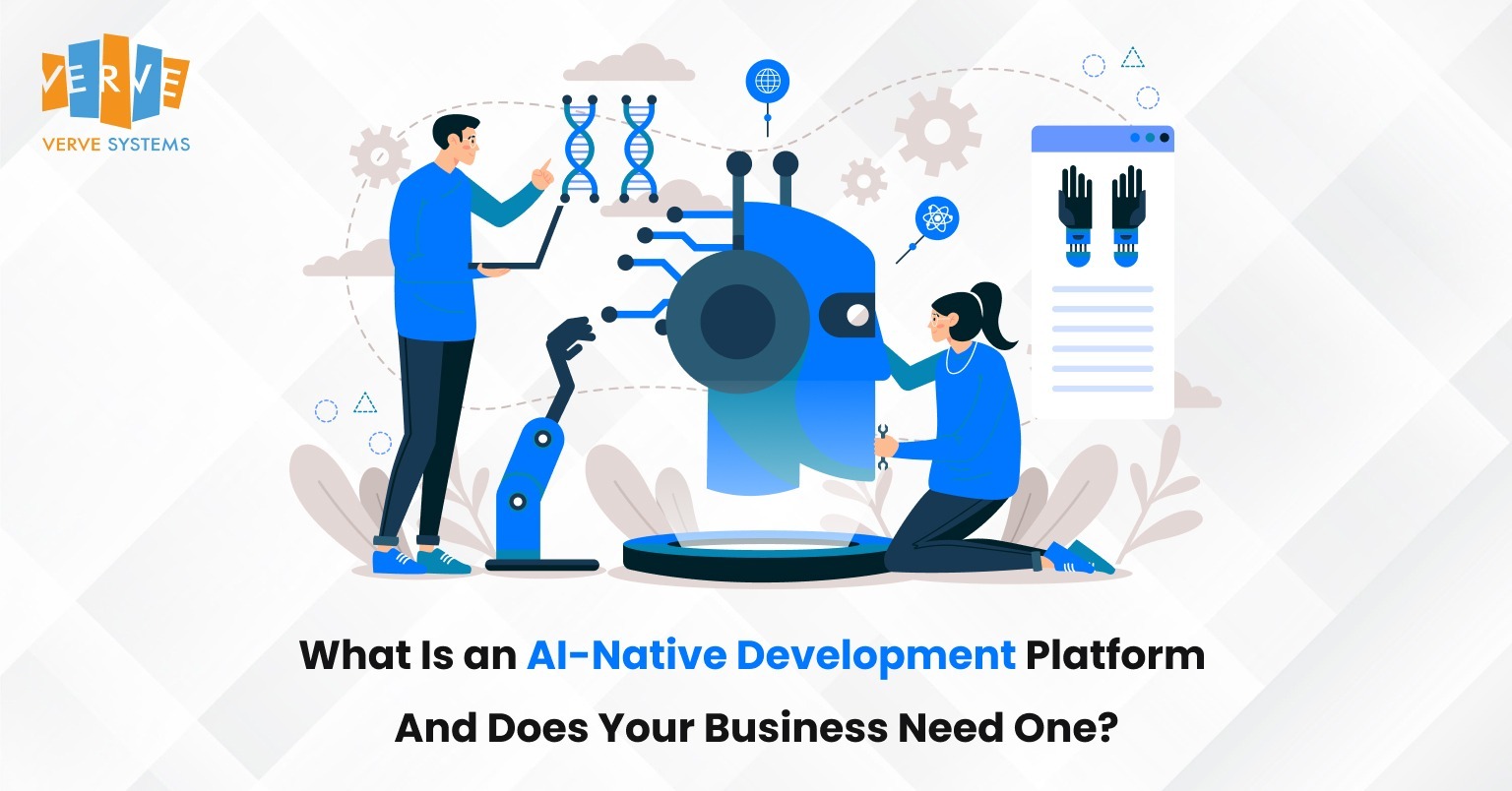
An AI native system is one that was designed from the ground up with artificial intelligence as a core architectural component — not as an add-on, not as a module, but as the foundation. The logic, the workflows, the data pipelines, the decision-making loops — all of it is built with AI as a first-class citizen.
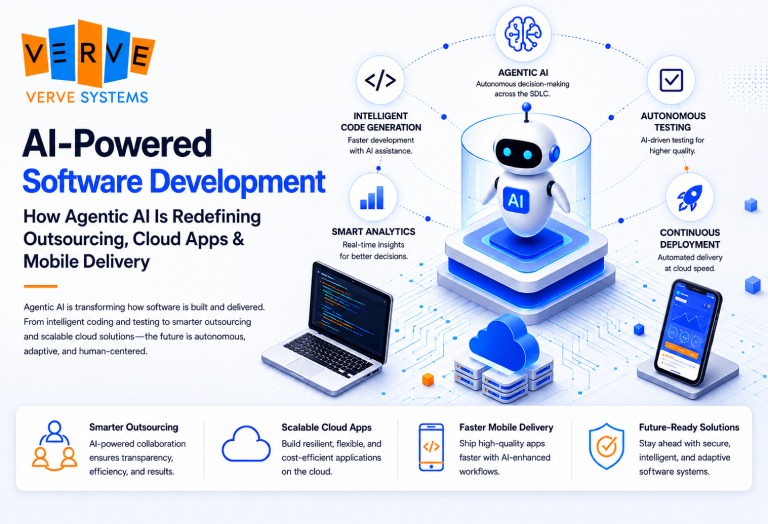
In the context of development platforms, “AI native” means the platform uses AI not just to assist developers but to fundamentally reshape how software is planned, written, tested, deployed, and optimized.
Think of it this way. Traditional development platforms give developers tools to build software. AI native development platforms give developers an intelligent partner that understands context, generates code, predicts errors, automates repetitive cycles, and continuously learns from the codebase and team behavior.
That is a meaningful difference.
How AI Native Platforms Work
Understanding how these platforms actually function helps you evaluate whether they fit your situation.
At their core, AI native development platforms are built around a few key capabilities:
Large Language Models and Code Generation
Modern AI native platforms use large language models (LLMs) — similar to the technology behind tools like GitHub Copilot or Cursor — to understand natural language instructions and translate them into working code. A developer can describe what a function should do in plain English, and the platform generates the implementation. This is not just autocomplete. It’s contextual, intent-driven code synthesis.
Semantic Understanding of Codebases
Unlike traditional IDEs that work with syntax, AI native platforms understand the meaning of your code. They can trace dependencies, understand the intent behind a function, and suggest changes that align with the existing architecture — not just technically valid changes.
Automated Testing and Quality Assurance
These platforms can automatically generate test cases, identify edge cases humans typically miss, and flag potential security vulnerabilities — all in real time during development, not after the fact.
Continuous Learning and Adaptation
The more your team uses an AI native platform, the more it learns. It picks up on your team’s conventions, your codebase’s patterns, and your deployment preferences. Over time, it becomes increasingly aligned with how your specific organization builds software.
Integration with the Full Development Lifecycle
A genuine AI native platform does not stop at writing code. It covers the entire software development lifecycle — from requirement analysis and architecture planning through to deployment, monitoring, and iteration. It connects all these stages through an intelligent layer that maintains context throughout.
AI Native Platform vs. Traditional Software Development
This is a comparison that a lot of businesses find clarifying.
In traditional software development, humans do most of the cognitive work. Developers write code manually, QA engineers test it, architects design systems, and project managers track progress. Tools assist — they provide syntax highlighting, version control, deployment pipelines — but the intelligence is almost entirely human.
The pace of traditional development is bottlenecked by human capacity. A team of ten developers can only produce so much in a sprint. There is inherent friction at every handoff — between design and development, between development and QA, between QA and deployment.
An AI powered development platform changes this equation significantly.
Development velocity increases because large portions of routine code — CRUD operations, boilerplate logic, API integrations — can be generated automatically. Developers shift from writing code line by line to reviewing, refining, and directing.
Quality improves because AI can evaluate code against thousands of best practices simultaneously, catching issues that individual developers might miss due to fatigue, unfamiliarity, or time pressure.
Onboarding accelerates because AI native platforms can explain existing code to new team members, reducing the time to productivity for new hires significantly.
Maintenance becomes more proactive. AI systems can monitor live applications, detect performance anomalies, and recommend or even implement optimizations without waiting for a human to notice a problem.
That said, traditional development is not obsolete. For small, simple projects, or in environments where regulatory or organizational constraints demand full human control over every line of code, traditional workflows remain appropriate. The point is not that AI native is always better — it is that it is better in specific and increasingly common contexts.
AI Native Architecture for Business: What Changes Under the Hood
For business and technology leaders who want to understand the structural implications — not just the surface features — here is what changes when you adopt an AI native architecture.
Data and Feedback Loops
AI native systems are feedback-hungry. They perform best when connected to real, rich data — usage analytics, error logs, user behavior signals, and performance metrics. If your organization does not have a robust data infrastructure, implementing an AI native platform will require foundational investment in data pipelines first.
Modularity and API-First Design
AI native architectures tend to favor modular, microservices-oriented designs. This is because AI systems need clean interfaces to interact with different parts of an application. If your existing systems are monolithic, migration to AI native development often involves a parallel refactoring effort.
Prompt Engineering as a Core Skill
In an AI native environment, the ability to communicate precisely with AI systems — to prompt them effectively — becomes a valuable skill. Teams that invest in developing this capability early see significantly better results from their AI platforms.
Governance and Oversight
Because AI systems can generate code autonomously, organizations need clear governance policies. Who reviews AI generated code before it goes to production? What are the standards for AI generated tests? What audit trails are required? These are not afterthoughts — they are foundational to safe adoption.
Benefits of AI Native Development: What the Research and Practice Show
Let’s be concrete about the benefits, because vague claims about “efficiency” and “innovation” help no one make a real decision.
Faster Time to Market
Studies across the industry consistently show that AI assisted development reduces time-to-delivery for new features by 30 to 50 percent. For businesses in competitive markets, this is a genuine strategic advantage.
Reduced Development Costs
By automating routine development tasks, AI native platforms allow you to do more with the same team — or the same with a smaller team. For many organizations, this translates directly to reduced cost per feature delivered.
Better Code Quality at Scale
Human developers make more mistakes as codebase complexity grows. AI native platforms do not suffer from cognitive overload in the same way. They can apply consistent quality standards across a million lines of code as easily as across a hundred.
Lower Barrier to Innovation
When teams spend less time on maintenance, bug fixes, and boilerplate development, they have more capacity for genuinely innovative work. AI native platforms shift the human contribution upward — from implementation to design, strategy, and creativity.
Improved Developer Experience
This one is often underestimated. Developer burnout is a real and expensive problem. AI native platforms reduce the most tedious parts of development work, which leads to higher satisfaction, better retention, and stronger hiring appeal.
AI Native Development Platform Examples
Let’s ground this in the real world. A few categories of AI native development platforms have emerged:
Full-Stack AI Development Environments
Platforms like Replit’s AI features, Cursor, or similar tools that integrate AI deeply into the code editing and project management experience. These are particularly popular with startups and product teams that want to move fast.
Enterprise AI Development Platforms
Solutions designed for large organizations that need AI native development capabilities alongside enterprise-grade security, compliance, access controls, and integration with existing DevOps pipelines. These are purpose-built for scale and governance.
Low Code AI Development Platforms
A growing category that allows non-developers or semi-technical users to build functional applications using AI guided visual interfaces. These are valuable for businesses that want to digitize internal workflows without hiring large engineering teams.
Generative AI Development Platforms Focused on Specific Domains
Some platforms specialize in building AI applications — for example, tools that make it easier for companies to build their own LLM-powered products, conversational AI systems, or AI enhanced data applications.
Domain-Specific Platforms
AI development tools built for particular industries or use cases — healthcare applications, fintech systems, logistics optimization tools — that incorporate domain-specific AI models alongside standard development capabilities.
Does Your Business Need an AI Native Platform? A Practical Framework
This is the question that actually matters. Let’s approach it honestly.
Signs Your Business Is Ready for an AI Native Development Platform
- You are struggling with development velocity. If your engineering team consistently cannot deliver features as fast as the business needs them, AI native tools can meaningfully close that gap.
- You have a backlog of technical debt. AI native platforms can help you systematically address legacy code issues while continuing to ship new features — something that is very difficult with traditional development resources.
- You are scaling your engineering team. When you are hiring aggressively, AI native tools allow new team members to contribute more quickly and help senior engineers do more leveraged work.
- You are building AI powered products. If your product strategy involves AI features — recommendations, personalization, automation, natural language interfaces — an AI native development platform significantly accelerates your ability to build and iterate on those capabilities.
- You are competing in a fast-moving market. In industries where the competitive advantage is speed of product development, AI native platforms are increasingly table stakes, not differentiators.
Signs You May Not Need One Yet
- Your current development process is working well, and the main bottlenecks are elsewhere — in product strategy, sales, or operations rather than engineering execution.
- Your team is very small and works on a narrow, well-defined set of technical problems where AI augmentation would add complexity without meaningful benefit.
- Your organization has significant regulatory constraints that require extremely high human oversight of all code, and the governance overhead of AI generated code would outweigh the benefits.
- You are in the early stages of building out basic technical infrastructure, and AI native development is aspirationally ahead of where your organization currently is.
AI Native Platform for Small Business: Is It Worth It?
A common misconception is that AI native development platforms are only for large enterprises with sophisticated engineering organizations. That is increasingly not true.
The emergence of low-code AI development platforms and accessible SaaS-based AI development tools has brought AI native capabilities within reach of small and mid-sized businesses. A team of three developers using the right AI native platform can often out-produce a team of ten using traditional tools.
For small businesses, the key consideration is not “can we afford this” but “can we afford not to.” If your competitors are moving to AI native development and you are not, the gap in delivery speed and product quality will compound over time.
That said, small businesses need to be thoughtful about which platform they choose. Enterprise-grade platforms built for Fortune 500 companies may have feature sets, pricing models, and implementation complexity that do not fit a small team. The right answer is usually a platform that provides AI native capabilities in a form factor that matches your team’s size and technical maturity.
AI Platform ROI for Business: How to Think About the Numbers
Decision-makers naturally want to understand the return on investment before committing to a new platform. Here is a reasonable framework for thinking about AI platform ROI.
Cost Side
- Platform licensing fees
- Implementation and migration costs
- Training time for your team
- Potential integration work with existing tools
Benefit Side
- Reduced developer hours per feature delivered
- Reduced QA and debugging costs
- Faster time to revenue from new products or features
- Reduced turnover from improved developer experience
- Reduced long-term maintenance costs
For most mid-sized technology organizations, the math tends to look favorable within 12 to 18 months of successful adoption — though this depends heavily on how well the platform is implemented and how thoroughly the team adopts it.
The important caveat: ROI projections for AI native platforms that are based purely on vendor claims should be treated with significant skepticism. Ask for case studies from organizations similar to yours in size and industry. Pilot before you commit. Measure what matters to your business specifically, not generic industry benchmarks.
AI Native Platform vs. Cloud Platform: Understanding the Difference
One point of confusion that comes up frequently is the relationship between AI native platforms and cloud platforms. They are not the same thing, and they are not mutually exclusive.
Cloud platforms — AWS, Google Cloud, Microsoft Azure — provide the infrastructure on which applications run. They offer compute, storage, networking, and an increasingly rich set of managed services, including AI and ML services.
AI native development platforms are the environments in which software is designed and built. They can run on top of any cloud provider — or on-premises, in hybrid configurations, or as SaaS products managed entirely by the vendor.
In practice, many AI native development platforms are cloud-native in their architecture — meaning they are designed to leverage cloud infrastructure effectively. But adopting an AI native development platform does not require migrating your cloud provider, and switching cloud providers does not give you AI native development capabilities on its own.
Think of it this way: the cloud is where your applications live. The AI native development platform is how you build them.
AI Platform for Software Development: The Growing Opportunity
Software development has become a truly global industry, powered by distributed talent, cloud infrastructure, and cross-border collaboration. As organizations compete to deliver faster, smarter, and more scalable solutions, the adoption of AI-native development platforms is emerging as both a major opportunity and a strategic necessity.
For software development firms worldwide, AI-native platforms offer a path to move beyond traditional, labor-intensive delivery models toward intelligence-amplified execution. The competitive landscape is evolving rapidly. Future advantage will not be defined solely by the size of the workforce, but by how effectively teams are augmented with AI to enhance productivity, quality, and innovation.
For enterprises working with development partners across the globe, a critical question is: What is your AI-native capability? Are your partners leveraging AI-augmented development practices to accelerate outcomes, or are they still dependent on largely manual workflows?
In this new era, success will belong to organizations that combine global talent with intelligent systems—transforming how software is built, delivered, and scaled.
When to Adopt AI Native Development: A Timeline Perspective
Timing matters in technology adoption. Too early and you bear the cost of immaturity in tools and practices. Too late, and you fall behind.
Right now — mid-2020s — we are at an inflection point for AI native development platforms. The technology has moved past early adopter experimentation into enterprise-viable deployment. Leading organizations across industries are implementing these platforms not as experiments but as standard operating practice.
The organizations waiting for the technology to “mature more” before adopting are increasingly at risk of falling into a structural disadvantage. The platforms are mature enough for production use. The question is whether your organization is ready to adapt — not whether the technology is ready for you.
The businesses that will have the most significant advantage by 2026 and 2027 are the ones that began thoughtful adoption in 2024 and 2025. That window is still open, but it is narrowing.
AI Development Services for Organizations: What to Look for in a Partner
If your organization is evaluating AI native development platforms or looking for guidance on how to adopt them effectively, the right partner matters as much as the right platform.
Here is what to look for:
- Genuine technical depth in AI development — not just AI product knowledge, but experience building systems with AI as a core component.
- A track record with organizations similar to yours — in size, industry, and technical maturity.
- An honest approach to scoping — partners who tell you what AI native platforms cannot do, not just what they can, are partners worth trusting.
- A clear implementation methodology — adoption of AI native platforms is as much a change management challenge as a technical one. The right partner will have a structured approach to both.
- Ongoing support and optimization capability — the value of AI native platforms compounds over time, but only with continuous tuning and support.
What Makes a Platform Truly AI Native: A Checklist for Evaluators
If you are evaluating specific platforms, here are the characteristics that genuinely distinguish AI native platforms from AI augmented ones:
- AI is embedded in the core architecture, not added as a feature layer
- The platform can understand semantic intent, not just syntactic patterns
- It learns and adapts from usage by your specific team and codebase
- It covers the full development lifecycle, not just one stage
- It provides explainable outputs — you can understand why it made a recommendation
- It integrates with your existing tools and workflows without requiring a complete overhaul
- It has enterprise-grade security and governance controls for AI generated outputs
- The vendor has a clear roadmap for how the AI capabilities will continue to evolve
Platforms that check most of these boxes are genuinely AI native. Platforms that check only a few are likely AI augmented tools marketed with AI native language.
Final Thoughts: Should Your Business Adopt an AI Native Development Platform?
Let’s bring it home.
If your business builds software — whether that is your core product, your internal tools, or the digital systems that power your operations — the question is not really “do we need AI native development?” The question is “when and how.”
The efficiency gains are real. The quality improvements are real. The competitive implications are real. Organizations that develop AI native development capabilities now will have structural advantages in speed, quality, and cost that will be very difficult for laggards to close.
The risk of adoption is real, too — wrong platform choice, poor implementation, inadequate change management, and insufficient governance can create problems that outweigh the benefits. This is why the “when and how” matters as much as the “whether.”
At Verve Systems, we work with organizations across industries to help them navigate exactly this decision — evaluating the right platforms, designing the right implementation approach, and building the internal capability to sustain and scale AI native development over time. We bring both the technical depth and the business context to make these transitions successful, not just technically sound.
If you are at the point of seriously evaluating AI native development for your organization, we would welcome the conversation.