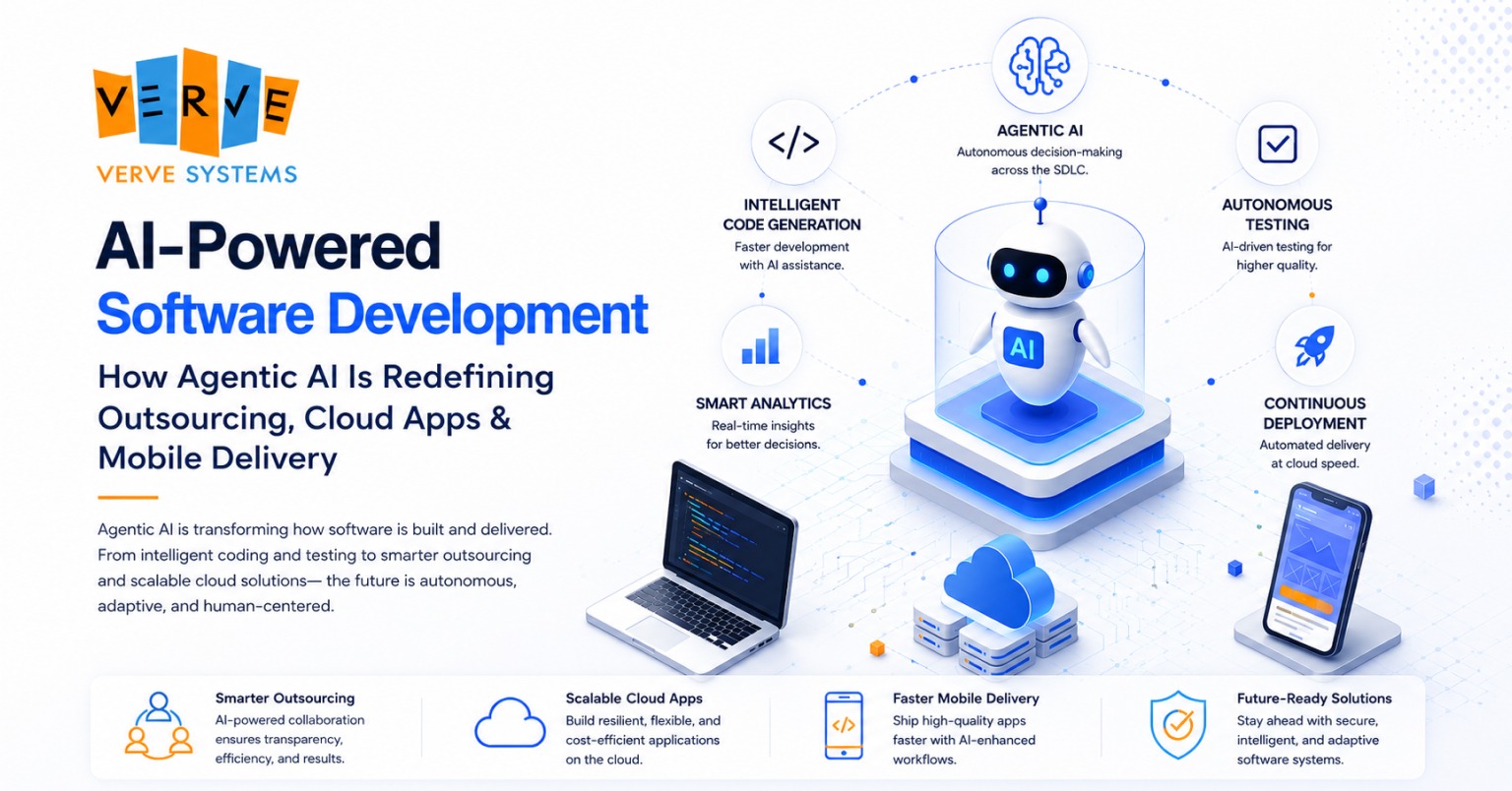
Expert TL;DR: Agentic AI is no longer an experimental layer on top of traditional software delivery – it has become the operating system of modern engineering teams. In 2026, the market for AI agents has crossed $11.78 billion, and Gartner projects 40% of enterprise applications will embed task-specific AI agents by year-end. For businesses evaluating software outsourcing, cloud app development, or mobile delivery, understanding agentic AI is no longer optional – it is the price of entry.
What Is Agentic AI and Why Does It Matter in 2026?
Agentic AI refers to AI systems that can autonomously plan, execute multi-step tasks, use external tools, and adapt based on feedback – without requiring a human prompt at every step.
Unlike traditional AI assistants that respond to single queries, agentic AI operates across the entire software development lifecycle: it can write code, run tests, debug failures, generate documentation, open pull requests, and coordinate with other agents – all within a single session. According to Anthropic’s 2026 Agentic Coding Trends Report, average coding agent session length grew from 4 minutes in Q1 2025 to 23 minutes in Q1 2026, a direct signal that agents are taking on substantially more complex work.
This shift has profound implications for every business that builds, buys, or outsources software.
The Five Forces Driving Agentic AI Adoption in Software Development
- Multi-agent orchestration: Multiple specialized agents collaborating like members of a scrum team, each handling distinct tasks such as security review, API integration, or UI rendering.
- AI-native software architecture: Applications designed from the ground up to be operated or managed partially by agents, changing how interfaces and workflows are structured.
- CLI-based agentic coding: Developers orchestrating agents via command-line interfaces, enabling end-to-end automation of feature delivery pipelines.
- Guardian agents for quality assurance: Dedicated AI agents that monitor, review, and flag agent-generated code for security, compliance, and logic errors.
- Democratized agent building: Low-code and no-code platforms enabling product managers, QA analysts, and non-engineers to create and configure AI agents independently.
Key Statistic: Gartner predicts that by the end of 2026, 40% of enterprise applications will include task-specific AI agents – up from less than 5% in 2025. That is an 8x jump in a single year.
How Agentic AI Is Reshaping the Software Outsourcing Industry
The short answer: agentic AI has permanently changed what “value” means in a software outsourcing relationship.
The traditional outsourcing model traded labor arbitrage for cost reduction. A software outsourcing company in the USA or an offshore partner would bill by the hour, and the client received developers in exchange for time. That model is under pressure. In 2026, McKinsey data shows that 62% of organizations are experimenting with AI agents, with 23% already scaling agentic systems. Teams augmented with AI deliver output at a velocity that pure-headcount models cannot match.
What This Means for Businesses That Outsource Software Development
The outsourcing market itself remains enormous. The software development outsourcing market is estimated to reach $618 billion in 2026, up from $564 billion in 2025. But the composition of that value has shifted dramatically:
| Outsourcing Model (2023–2024) | Outsourcing Model (2026+) |
| Cost driven by headcount | Cost driven by output and velocity |
| Monthly billing, unclear milestones | Outcome-based contracts |
| Developers write most of the code | Developers orchestrate agents writing code |
| Quality is measured by code review volume | Quality measured by test pass rates & agent accuracy |
| Onboarding takes 2–4 weeks | AI-assisted onboarding in 3–5 days |
| Time-and-materials standard | Performance-bonused, fixed-scope preferred |
Companies that hire a dedicated software development team in 2026 should be asking a fundamentally different set of questions: not just “how many developers do you have,” but “what is your AI toolchain, what is your agent oversight process, and can you show measurable productivity benchmarks?”
Real-World Evidence: What Agentic Productivity Looks Like
- TELUS used Claude Code to ship engineering output 30% faster while saving over 500,000 engineering hours, averaging 40 minutes saved per AI interaction.
- Rakuten used an agentic coding tool to add a feature to a 12.5-million-line codebase in 7 hours with 99.9% accuracy – a task that would have taken a team of developers weeks.
- Cisco has adopted spec-driven development with AI agents: a team of 8 has been restructured to 3 humans and 5 digital agents, tripling output.
These are not edge cases. These are the benchmarks that enterprise buyers now use when evaluating outsourcing partners.
Offshore Development Centers in the Age of AI: What Has Changed?
An Offshore Development Center (ODC) is a dedicated team of engineers – typically located in a lower-cost geography – that operates as an embedded extension of a client’s in-house engineering function.
In a traditional ODC model, the client gains access to talent and cost reduction, with the tradeoff of communication overhead and time-zone friction. In 2026, the AI layer has fundamentally transformed the ODC value proposition.
What Is an Offshore Development Center and How Does It Work in 2026?
An AI-augmented ODC functions as follows:
- Discovery & Architecture: Senior architects and product leads (client-side or ODC-side) define the system architecture, business rules, and API contracts.
- Agent-Orchestrated Development: Developers configure and oversee agentic coding tools that handle boilerplate, test writing, documentation, and routine feature implementation.
- Human-in-the-Loop Review: Engineers review agent output, handle edge cases, and make architectural judgment calls that AI cannot reliably perform.
- Automated CI/CD + QA Agents: Pipelines run continuously, with guardian agents flagging regressions, security vulnerabilities, and performance regressions before human review.
- Outcome Reporting: Clients receive velocity metrics, bug rates, and deployment frequency data – not just timesheets.
The Cost Equation Has Improved – But the Vendor Selection Bar Is Higher
- Offshore development can deliver cost savings of up to 40% compared to onshore US development, with nearshore options running up to 46% cheaper.
- The US has approximately 1.4 million unfilled technical positions against only 400,000 annual computer science graduates – a structural talent gap that makes offshore teams strategically necessary, not just economically convenient.
- However, cultural misalignment remains a cause of failure in 60% of offshore projects. In 2026, this risk has not decreased – it has intensified as the human coordination layer becomes even more critical in an agentic workflow.
Verve Systems Insight: The best offshore development center partnerships in 2026 are not just staff augmentation arrangements. They are co-innovation relationships where the ODC partner brings AI tooling, agentic workflows, and outcome-based accountability to the table – not just developer hours.
Cloud-Native App Development + Agentic AI: A New Velocity Standard
Cloud-native application development refers to building software using microservices, containers, Kubernetes orchestration, and continuous delivery pipelines – designed to run and scale natively in cloud environments.
In 2026, cloud-native is not a methodology – it is the baseline. The cloud native applications market grew from $11.18 billion in 2025 to $13.89 billion in 2026 at a CAGR of 24.3%, and is projected to reach $33.37 billion by 2030. The integration of agentic AI into cloud-native pipelines has created a new performance floor that clients of cloud app development services now expect.
How Agentic AI Accelerates Cloud-Native Delivery
- Infrastructure as Code (IaC) generation: AI agents can generate Terraform or Pulumi configurations from architectural diagrams, reducing provisioning time from days to hours.
- Kubernetes manifest optimization: Agents continuously review and adjust resource limits, autoscaling policies, and pod configurations based on live traffic patterns.
- Automated security scanning: Guardian agents run OWASP, SAST, and dependency vulnerability scans on every pull request, flagging issues before they reach production.
- Cost optimization bots: AI-based auto-scaling and anomaly detection tools continuously tune cloud spend, reducing waste across multi-cloud deployments.
- Observability-driven incident response: Agents monitor distributed traces and logs, identify the root cause of incidents, and propose (or auto-apply) fixes within defined guardrails.
SaaS Product Development in 2026: The AI-Native Stack
For SaaS product development companies building multi-tenant platforms, the agentic AI layer is now embedded across the product lifecycle:
| Phase | Traditional Approach | AI-Augmented Approach (2026) |
| Requirements | User stories written by PM | AI-generated requirements from user interview transcripts |
| Architecture | Whiteboard sessions | AI-suggested microservice decomposition with dependency mapping |
| Development | Developers write feature code | Agents write first-pass code; devs review and refine |
| QA Testing | Manual + scripted test suites | AI-generated test cases covering edge cases automatically |
| Deployment | Manual pipeline configuration | Agents optimize blue-green deploy strategies in real time |
| Post-Launch | Reactive bug fixing | Agents detect anomalies and propose patches proactively |
Key Metric: PaaS spending is projected to reach $227.16 billion by 2030, up 65% from an estimated $137.4 billion in 2025, as cloud-native platforms become the standard infrastructure layer for every software product.
Flutter App Development and AI-Augmented Mobile Delivery
Flutter, Google’s open-source UI toolkit, continues to lead the cross-platform mobile development market in 2026 – and when combined with AI-augmented development workflows, it represents the most cost-effective path to high-quality mobile delivery across iOS, Android, and web.
Flutter’s Market Position in 2026
According to the Stack Overflow Developer Survey and Statista, Flutter holds approximately 46% of the cross-platform mobile development market, compared to React Native’s 35%. Together, they command over 80% of the cross-platform market.
What makes Flutter the preferred choice for mobile app development outsourcing in 2026:
- Single codebase: One Dart codebase targets iOS, Android, web, and desktop simultaneously, reducing development and maintenance overhead.
- Impeller rendering engine: Flutter’s next-generation renderer achieves 96% of native performance on Android and 91% on iOS, effectively ending the “jank” era of cross-platform apps.
- Cost efficiency: Cross-platform development with Flutter yields up to 40% savings in R&D costs compared to maintaining separate native codebases.
- AI tooling compatibility: Flutter’s Dart ecosystem now integrates cleanly with AI code generation tools, enabling agentic workflows that accelerate widget development and state management.
Flutter vs. React Native: 2026 Comparison Table
| Criteria | Flutter | React Native |
| Market Share | 46% | 35% |
| Language | Dart | JavaScript / TypeScript |
| Rendering | Custom Impeller engine | Native components (Fabric) |
| Performance | 96% native (Android) | Near-native via Fabric |
| Code Reuse | ~85–95% across platforms | ~70–90% across platforms |
| Community Size | Large, growing fast | Largest, Meta-backed |
| Best For | UI-heavy, visual apps | Apps with heavy native integrations |
| AI Tool Support | Strong (Cursor, Copilot, Claude) | Strong (Copilot, Tabnine) |
How AI Is Accelerating Flutter App Delivery at Verve Systems
When a Flutter app development company integrates agentic AI into its delivery workflow, the benefits compound across the project lifecycle:
- Widget generation: Agents generate standard Flutter widgets from Figma designs, reducing UI implementation time by 50–70%.
- State management scaffolding: AI tools automatically scaffold BLoC, Riverpod, or Provider patterns based on the chosen architecture.
- Automated test generation: Agents write widget tests and integration tests alongside feature code, ensuring coverage without additional sprint allocation.
- API integration: Agents generate Dart model classes, HTTP client code, and error handling layers from OpenAPI specifications automatically.
- App store submission support: Agents generate release notes, screenshot metadata, and compliance checklists for both App Store and Google Play.
By the end of 2026, nearly 50% of developers are expected to rely on cross-platform tools like Flutter, driven by faster development cycles and the business requirement to support multiple platforms from a single codebase.
How to Choose a Software Outsourcing Company in 2026 (Checklist)
The right software outsourcing company in 2026 combines domain expertise, AI-augmented delivery, transparent outcome metrics, and strong communication practices.
Use this checklist when evaluating any software outsourcing company in the USA or offshore partner:
AI Capabilities & Toolchain
- Do they have documented agentic AI workflows (not just GitHub Copilot)?
- Can they demonstrate measurable productivity benchmarks (velocity, bug rate, deployment frequency)?
- Do they use AI-assisted code review and automated security scanning?
- Are they keeping pace with the latest model releases (Claude, GPT, Gemini integration)?
Delivery Model & Accountability
- Do they offer outcome-based contracts, not just time-and-materials?
- Are sprint deliverables, KPIs, and escalation paths clearly defined?
- Do they provide live project dashboards with real-time visibility?
Technical Expertise
- Cloud-native stack: microservices, Kubernetes, CI/CD pipelines?
- Mobile: Flutter or React Native experience with production app references?
- Backend: Node.js, Python, Go, Java, and cloud platforms (AWS, GCP, Azure)?
- Security: ISO/IEC 27001 compliance, OWASP practices, NDAs in place?
Communication & Culture
- Overlap of at least 4 working hours with your time zone?
- Dedicated Project Manager or Engagement Manager, not just developers?
- Track record with clients in your industry vertical?
Pricing & Scalability
- Can the team scale up or down within 2–4 weeks?
- Are rates transparent, with no hidden fees for tooling or management?
- Do they offer fixed-price MVP engagements for early-stage projects?
Key Market Data: AI Software Development Statistics at a Glance
The following data table aggregates the most critical statistics for decision-makers evaluating AI software development partnerships, digital transformation investments, and software outsourcing strategies in 2026. Original compilation by the Verve Systems research team.
| Metric | Value | Source |
| Agentic AI market size (2026) | $11.78 billion | Belitsoft / Market Research |
| Agentic AI market projection (2034) | $251.38 billion | Belitsoft Forecast 2026 |
| Gartner: Enterprise apps with AI agents by the end of 2026 | 40% | Gartner |
| AI agent adoption as a top enterprise priority YoY growth | +31.5% | Futurum Group |
| TELUS: Engineering hours saved with Claude Code | 500,000+ hours | Anthropic 2026 Report |
| TELUS: Code delivery speed improvement | +30% | Anthropic 2026 Report |
| Average ROI on generative + agentic AI (2026) | 49% ($1.49 per $1 invested) | Belitsoft / PwC |
| Software outsourcing market size (2026) | $618 billion | Geniusee Research |
| Outsourcing cost savings vs. onshore US | Up to 40% | SQ Magazine |
| US unfilled tech positions (2025) | 1.4 million | Geniusee Research |
| Flutter cross-platform market share | 46% | Stack Overflow / Statista |
| React Native cross-platform market share | 35% | Stack Overflow / Statista |
| Cloud native applications market (2026) | $13.89 billion | Business Research Company |
| Cloud native applications market projection (2030) | $33.37 billion | Business Research Company |
| McKinsey: Organizations experimenting with AI agents | 62% | McKinsey State of AI 2025 |
| Gartner: Engineers shifting to AI orchestration by 2026 | 90% | Gartner |
| PwC: Businesses using AI agents report productivity gains | 66% | PwC Survey 2026 |
Table compiled by Verve Systems Editorial Team using publicly available industry research (May 2026). Individual source links provided throughout the article.
Verve Systems: AI-Powered Software Development Built for 2026
Verve Systems is a full-stack custom software development company with over a decade of delivery experience across cloud-native applications, mobile platforms, and enterprise SaaS products. In 2026, Verve has integrated agentic AI tooling across its delivery workflows – not as a marketing claim, but as a measurable operational commitment.
What Verve Systems Delivers
Custom Software Development for Business. From SaaS platforms and enterprise portals to workflow automation tools and data products – Verve engineers build software aligned to business outcomes, not just technical specifications.
Cloud App Development Services: Full-stack cloud-native delivery using AWS, GCP, and Azure. Microservices architecture, Kubernetes orchestration, CI/CD automation, and observability-first engineering.
Flutter App Development Company: Cross-platform mobile applications for iOS, Android, and web from a single Flutter codebase. UI-rich, performance-optimized, and AI-development-assisted from design to deployment.
Offshore Development Center (ODC) Model Dedicated teams that operate as embedded extensions of your engineering function – with AI-augmented velocity, transparent metrics, and clear accountability frameworks.
MVP Development for Startups: Rapid MVP delivery with fixed-scope engagements. Verve helps early-stage companies validate product hypotheses before committing to full-scale engineering investment.
Hire a dedicated software development team. Scale your engineering capacity on demand – individual developers or full cross-functional teams – integrated with your tools, workflows, and sprint cadence.
Why Clients Choose Verve Systems
- AI-augmented delivery: Agentic coding tools integrated across the SDLC, with documented productivity benchmarks available to clients.
- Outcome-based accountability: Verve measures success by shipped features, deployment frequency, and product quality – not timesheets.
- Senior-led teams: Engagement leads with 16+ years of experience, supported by developers who understand both the code and the business context.
- Transparent communication: Regular sprint reviews, live dashboards, and dedicated project managers – no black boxes.
- Security-first practices: ISO/IEC 27001-aligned processes, OWASP coding standards, and mandatory NDAs before project commencement.
Ready to modernize your software delivery? Contact Verve Systems to discuss your project, request a free technical consultation, or explore dedicated team models for your engineering roadmap.